
COMMUNITY CAMPAIGN
Data Centre Concerns
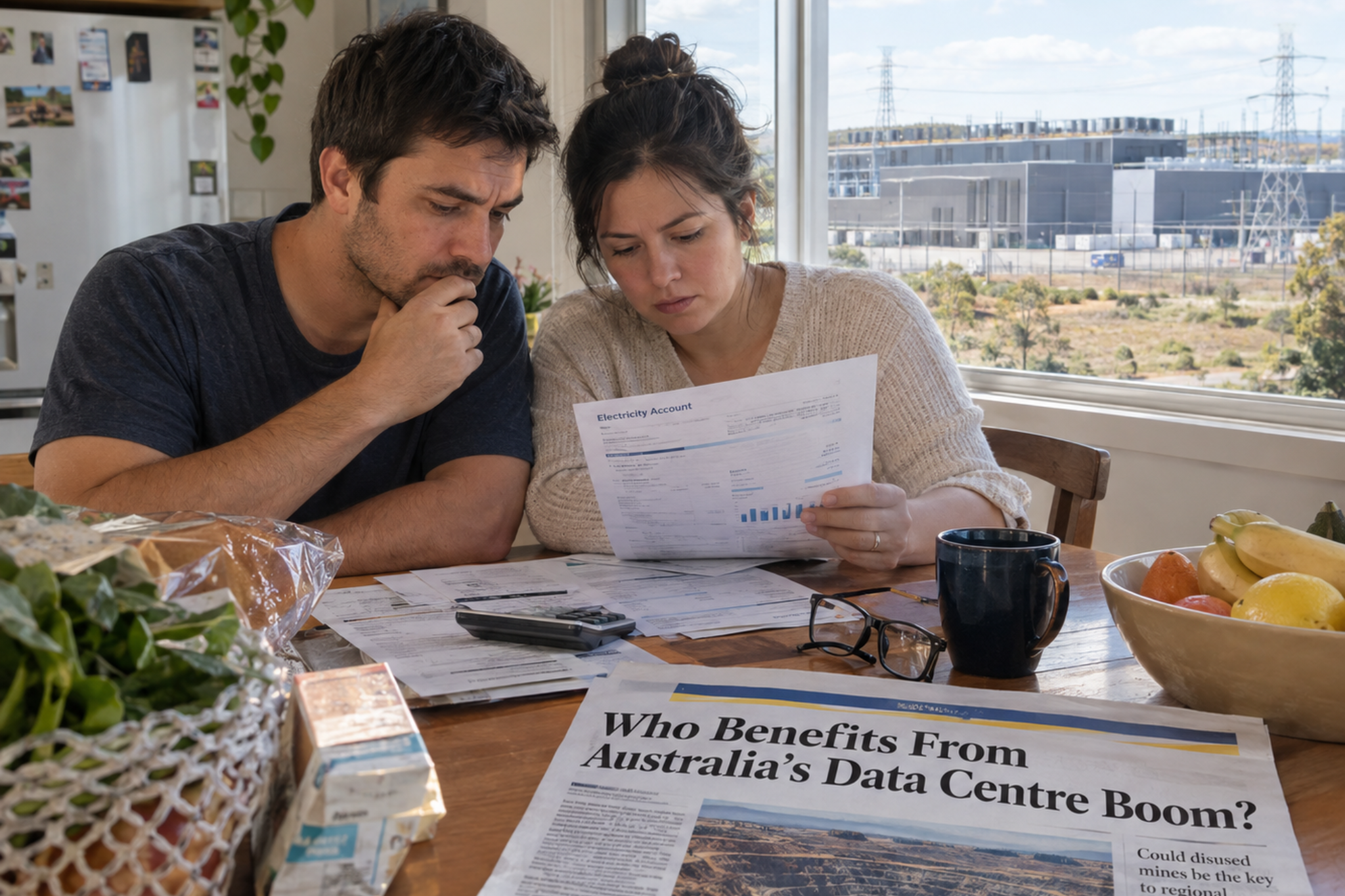
Australia is building more data centres.
But what does that mean for your community?
COMMUNITY CAMPAIGN
Data Centre Concerns
Australia is building more data centres.
But what does that mean for your community?
What’s behind the Data Centre Concerns

Australia already has 165 data centres operating, with at least 225 more proposed. By 2030, AEMO projects data centres could account for around 6% of the electricity supplied through the main grid.
A data centre is a warehouse, it's not built for people.
They use huge amounts of electricity and generate enormous heat, so they need powerful cooling systems, often using large amounts of water. Outside, rows of diesel generators stand ready if the power goes out.
And they’re getting bigger, fast.
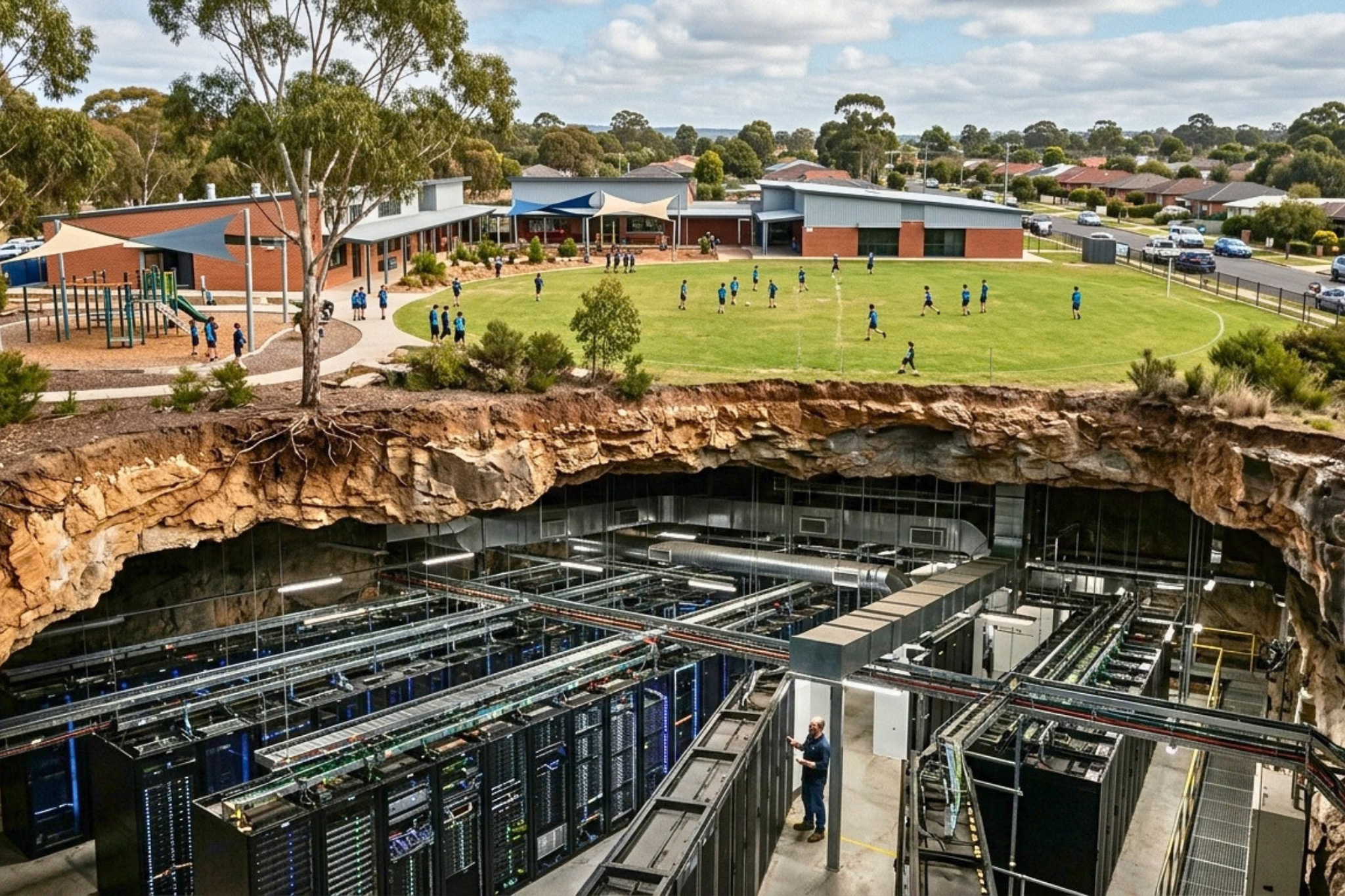
That’s why we’ve put together a submission report to the Senate inquiry into artificial intelligence and data centres, calling for a national framework for data centres to be built underground, in disused mines where possible.
We have thousands of disused mines, and world-class mining and tunnelling expertise to do it.
What’s behind the Data Centre Concerns
Australia already has 165 data centres operating, with at least 225 more proposed. By 2030, AEMO projects data centres could account for around 6% of the electricity supplied through the main grid.
A data centre is a warehouse, it's not built for people.
They use huge amounts of electricity and generate enormous heat, so they need powerful cooling systems, often using large amounts of water. Outside, rows of diesel generators stand ready if the power goes out.
And they’re getting bigger, fast.
That’s why we’ve put together a submission report to the Senate inquiry into artificial intelligence and data centres, calling for a national framework for data centres to be built underground, in disused mines where possible.
With thousands of disused mines, and world-class mining and tunnelling expertise to do it.
Why it matters
Growth in data centres on its own isn’t the problem. The concern is that it's arriving faster than the rules built to manage it — and the costs land on households that were never asked.
Every new data centre needs power, water and infrastructure to support it. If those costs aren’t covered by the companies connecting, they can ultimately flow to other users.
And the numbers show just how significant the scale is.
25%
of Sydney’s drinking water could be used by data centres by 2035, up from less than 1% today.
$51.4B
worth of 20 data centre projects currently in NSW’s State Significant Development pipeline.
44 GW
of data-centre connection requests in the first six months of 2025.
These buildings could operate for decades, so the choices we make about where and how they’re built will shape our communities for years to come. Now is the time to have your say.
Why it matters
Growth in data centres on its own isn’t the problem. The concern is that it's arriving faster than the rules built to manage it — and the costs land on households that were never asked.
Every new data centre needs power, water and infrastructure to support it. If those costs aren’t covered by the companies connecting, they can ultimately flow to other users.
And the numbers show just how significant the scale is.
25%
of Sydney’s drinking water could be used by data centres by 2035, up from less than 1% today.
$51.4B
worth of 20 data centre projects currently in NSW’s State Significant Development pipeline.
44 GW
of data-centre connection requests in the first six months of 2025.
These buildings could operate for decades, so the choices we make about where and how they’re built will shape our communities for years to come.
Now is the time to have your say.
The Data Centre concerns being raised
The ordinary questions people ask when a data centre proposal lands near them.
⚡ How much electricity will it use?
💧 Where will the water come from?
🏠 What happens if one is built near my home?
🚧 What will construction mean for local roads and traffic?
🏗️ Who checks that it is built properly?
🛡️ Who makes sure it keeps operating safely?
⚠️ What happens if something goes wrong?
📣 Who do I talk to if I have a concern?
You shouldn’t need to be an engineer, planner or data centre expert to ask these questions.

But getting answers isn’t always simple. Responsibility can sit across developers, councils, state planning authorities, energy providers, water authorities and other regulators.
When something goes wrong, knowing who to contact shouldn’t be another problem.
The Data Centre concerns being raised
The ordinary questions people ask when a data centre proposal lands near them.
⚡ How much electricity will it use?
💧 Where will the water come from?
🏠 What happens if one is built near my home?
🚧 What will construction mean for local roads and traffic?
🏗️ Who checks that it is built properly?
🛡️ Who makes sure it keeps operating safely?
⚠️ What happens if something goes wrong?
📣 Who do I talk to if I have a concern?
You shouldn’t need to be an engineer, planner or data centre expert to ask these questions.
But getting answers isn’t always simple. Responsibility can sit across developers, councils, state planning authorities, energy providers, water authorities and other regulators.
When something goes wrong, knowing who to contact shouldn’t be another problem.
Who’s responsible for data centre concerns
One data centre. Lots of players. Not one place to complain.
🏗️ Who’s involved
👷 Developers
⚙️ Operators
🧱 Builders
🏛️ Councils
🔌 Infrastructure providers
📋 Government agencies
📣 Where you can complain
⚡ Issue with your electricity provider? → Energy ombudsman
🏦 Complaint against your bank? → Financial complaints process
❌ Problem with a data centre? → No dedicated complaints body
If 100 people are experiencing the same problem, it shouldn’t take 100 separate complaints for someone to realise there’s a bigger issue.
Who’s responsible for data centre concerns
One data centre. Lots of players. Not one place to complain.
One data centre. Lots of players. Not one place to complain.
🏗️ Who’s involved
👷 Developers
⚙️ Operators
🧱 Builders
🏛️ Councils
🔌 Infrastructure providers
📋 Government agencies
📣 Where you can complain
⚡ Issue with your electricity provider? → Energy ombudsman
🏦 Complaint against your bank? → Financial complaints process
❌ Problem with a data centre? → No dedicated complaints body
If 100 people are experiencing the same problem, it shouldn’t take 100 separate complaints for someone to realise there’s a bigger issue.
What needs to change

If a data centre is planned near you, you deserve more than a planning application and a promise that everything will be fine.
In our submission to the Senate inquiry, we're calling for five changes:
🕳️ Make underground the default
Large data centres should look at disused mines first, then tunnels and caverns under cities. Building above ground should be the last option. If a developer wants to build above ground, they should have to explain why the alternatives won’t work.
⛏️ Turn old mines into assets
Create a national register of disused mines that could be suitable for data centres, with native title and heritage checks done first. If a company safely converts a mine void for a new use, that work should count towards its clean-up obligations.
📊 Publish what they actually use
Data centres should report their electricity and water use every year, so we can see what they’re really consuming. Drinking water shouldn’t be used for cooling, and larger sites should look for ways to reuse their waste heat.
💰 Make them pay for their own upgrades
If a project needs new power or water infrastructure, the company should cover the cost. The energy regulator should also report each year on whether any of those costs are being passed on to households.
📣 Give communities somewhere to complain
Set up a free, independent complaints scheme like the energy and telco ombudsmen. It should cover noise, generator emissions, light, traffic and water pressure, have the power to make binding decisions and publish its results.
What needs to change
If a data centre is planned near you, you deserve more than a planning application and a promise that everything will be fine.
In our submission to the Senate inquiry, we're calling for five changes:
🕳️ Make underground the default
Large data centres should look at disused mines first, then tunnels and caverns under cities. Building above ground should be the last option. If a developer wants to build above ground, they should have to explain why the alternatives won’t work.
⛏️ Turn old mines into assets
Create a national register of disused mines that could be suitable for data centres, with native title and heritage checks done first. If a company safely converts a mine void for a new use, that work should count towards its clean-up obligations.
📊 Publish what they actually use
Data centres should report their electricity and water use every year, so we can see what they’re really consuming. Drinking water shouldn’t be used for cooling, and larger sites should look for ways to reuse their waste heat.
💰 Make them pay for their own upgrades
If a project needs new power or water infrastructure, the company should cover the cost. The energy regulator should also report each year on whether any of those costs are being passed on to households.
📣 Give communities somewhere to complain
Set up a free, independent complaints scheme like the energy and telco ombudsmen. It should cover noise, generator emissions, light, traffic and water pressure, have the power to make binding decisions and publish its results.
Big projects. Bigger questions.
If a data centre is planned near you, tell us what concerns you.
If a data centre is planned near you, tell us what concerns you.
Big projects. Bigger questions.
If a data centre is planned near you, tell us what concerns you.
If a data centre is planned near you, tell us what concerns you.
The evidence behind the data centre concerns
Australia doesn’t have to start from scratch. We already have the skills, infrastructure and expertise to think differently about where and how data centres are built.
Explore the evidence behind some of the ideas we’re calling for.
Australia already has the expertise to think differently. Our mining, tunnelling and engineering experience could help us explore new approaches to data centre design and construction.
Key reporting
If you want to see how underground data centres work in practice, we’ve gathered real-world examples from overseas for you to explore.
Key reporting
Australian media has reported on the rapid growth of data centres and the questions being raised around electricity, water, infrastructure, planning and impacts on local communities.
Key reporting
The evidence behind the data centre concerns
Australia already has the expertise to think differently. Our mining, tunnelling and engineering experience could help us explore new approaches to data centre design and construction.
Key reporting
If you want to see how underground data centres work in practice, we’ve gathered real-world examples from overseas for you to explore.
Key reporting
Australian media has reported on the rapid growth of data centres and the questions being raised around electricity, water, infrastructure, planning and impacts on local communities.
Key reporting
A nationwide build-out. No national rules.
Data centres are expanding across Australia, but the standards governing their growth are still evolving.
Have a concern about a data centre near you? Share what’s happening.
Your experience could help identify patterns, raise questions and make sure community concerns are heard.
A nationwide build-out. No national rules.
Data centres are expanding across Australia, but the standards governing their growth are still evolving.
Have a concern about a data centre near you? Share what’s happening. Your experience could help identify patterns, raise questions and make sure community concerns are heard.
Data Centre Concerns
Is a data centre proposed, being built, or already running near you?
Whether you’ve been affected by construction, have questions about electricity or water, are concerned about your local area, or simply want answers, we want to hear from you.
Data Centre Concerns
Is a data centre proposed, being built, or already running near you?
Whether you’ve been affected by construction, have questions about electricity or water, are concerned about your local area, or simply want answers, we want to hear from you.

Register for updates and events
-
Public control: Lease underground sites to data centres
The Hazelwood Power Station, east of Melbourne, lies abandoned. The coal-fired operation helped keep the lights on in Victoria until it was decommissioned in 2017. Now the area around the Latrobe Valley site is ripe for another kind of development.
-

Waste not: Put data centre heat and wires to work
In the small Finnish town of Mantsala, north of Helsinki, residents are kept warm through the long winter by an unlikely source.
-
Going below: Underground data centres lead the way
Lefdal spreads over 120,000sqm – roughly the size of eight footy fields – and up six levels, with 75 distinct chambers. Yet this data centre in west Norway is barely a blip on the striking Nordic landscape.
-
Public control: Lease underground sites to data centres
The Hazelwood Power Station, east of Melbourne, lies abandoned. The coal-fired operation helped keep the lights on in Victoria until it was decommissioned in 2017. Now the area around the Latrobe Valley site is ripe for another kind of development.
-
Waste not: Put data centre heat and wires to work
In the small Finnish town of Mantsala, north of Helsinki, residents are kept warm through the long winter by an unlikely source.
-
Going below: Underground data centres lead the way
Lefdal spreads over 120,000sqm – roughly the size of eight footy fields – and up six levels, with 75 distinct chambers. Yet this data centre in west Norway is barely a blip on the striking Nordic landscape.