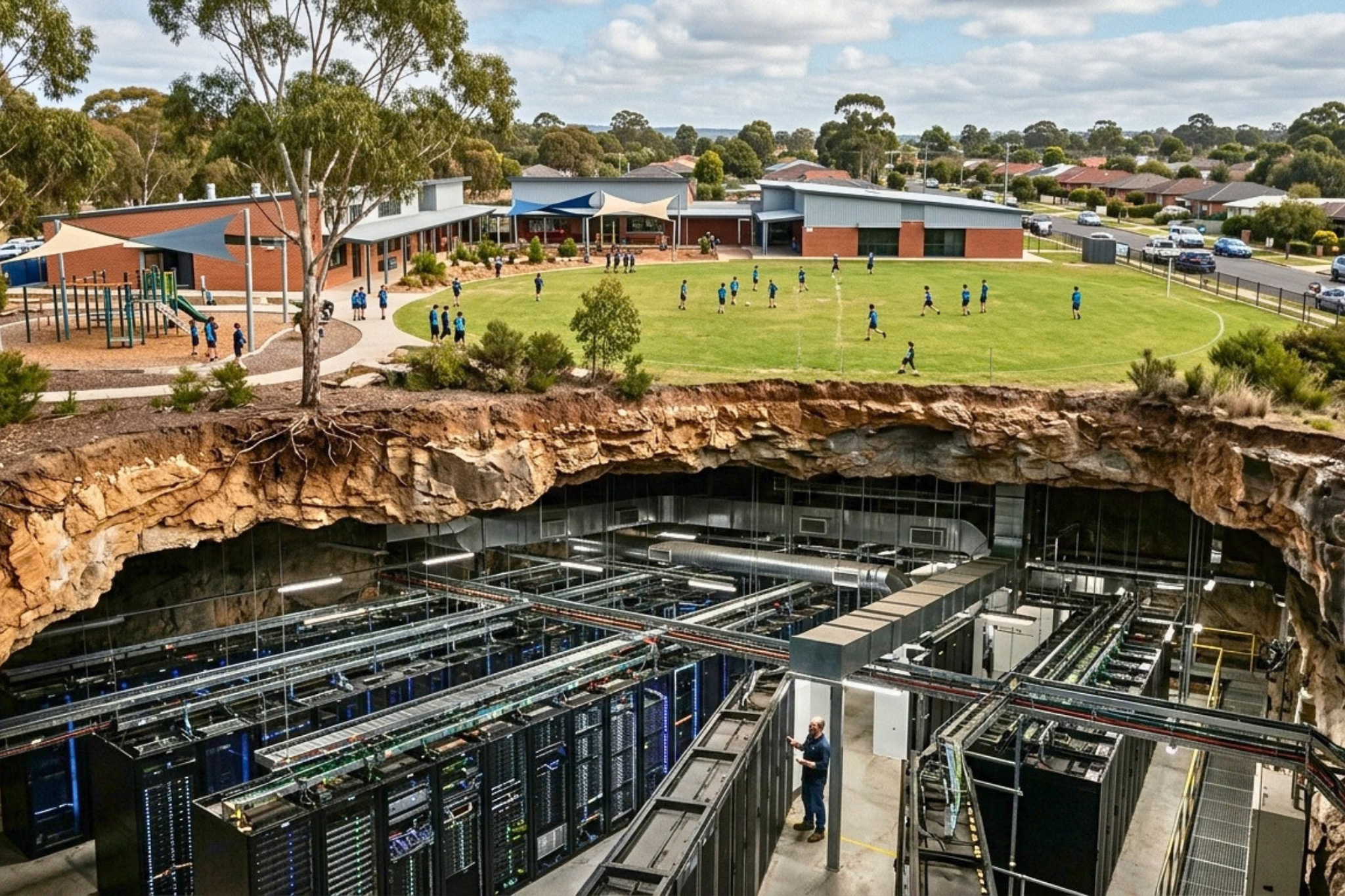

Public control: Lease underground sites to data centres
The Hazelwood Power Station, east of Melbourne, lies abandoned. The coal-fired operation helped keep the lights on in Victoria until it was decommissioned in 2017. Now the area around the Latrobe Valley site is ripe for another kind of development.
Singapore’s Keppel has secured leasing rights to more than 123ha for a $10 billion artificial intelligence campus. The site has access to the grid, water and fibre but the land is privately owned, so locals will not reap any of the benefits.
In a submission to state and federal governments, Handle My Complaint CEO Jo Ucukalo argues this model for data centre infrastructure lets down regional Australia once again.
"The region hosts the infrastructure and the rent goes to a private landholder,” she says. “Not only should we be putting these centres underground, we should be using publicly owned mine voids to ensure funds are returned to regional communities.”
|
Data centres: A special report Australia’s data centre boom is putting pressure on our power, water, land and communities. What if we built these facilities underground instead, ideally in disused mines that the states and territories already carry the cost of remediating? Our four-part series sets out our proposal to take data centres underground and shows what they can give back to the communities that host them. |
| Part one: Dig deep: The future of data centres in Australia |
| Part two: Going below: Underground data centres lead the way |
| Part three: Waste not: Put data centre heat and wires to work |
Booming private industry
Australia already has 165 data centres in operation, with another 225 in the pipeline. Most are built on private land and connect through private networks, often in city centres beside homes and schools, which creates its own issues.
Data centres: A second life for mine voids, a companion paper to Handle My Complaint’s earlier submission calling for data centres to be put underground, details the reasons why these centres are best located within existing infrastructure and the benefits this can bring to the public.
“The question is not whether this infrastructure should be built,” Ms Ucukalo says. “It’s whether its value flows to the public, or whether the public keeps paying for past infrastructure as well as funding the future.”
Governments are slowly starting to write the rules governing data centres in Australia. In August, the National Cabinet agreed to develop mandatory national standards for their use of energy and water. Victoria has released a Sustainable Data Centre Action Plan and New South Wales has its own framework.
While these are important steps, they deal with how data centres operate, not who shares in the value they create. “Nothing proposed so far says who owns the land, who owns the fibre, or what the public should get in return for hosting nationally significant infrastructure,” Ms Ucukalo says.
Turning liabilities into assets
Meanwhile, governments are inheriting the bill for past mining. Only 4 percent of Australia’s more than 80,000 inactive mine sites have been rehabilitated. When a bond falls short or the operator disappears, the land and liability for these voids revert to the state.
In 2020, the Victorian Auditor-General found a possible shortfall of up to $361 million against $813 million in rehabilitation bonds held by the state. In New South Wales, the bond held for clean-up of the Russell Vale colliery, 70km south of Sydney, was reported at $12 million, against the operator’s own estimate of $215 million.
“Taxpayers should not have to foot the bill, especially when there is a way to turn these liabilities into assets,” Ms Ucukalo says. “A disused void can become revenue-earning infrastructure.”
If Australian regulations make underground the default location for data centres, starting with mines that have already been dug up, the returns to the public can not only be measured in more desirable environmental and social outcomes but in better security and funding for areas that need it the most.
Lease, don’t sell
The key is to keep control of the land. Handle My Complaint proposes that data centres in a state-controlled void would be a tenant, not an owner. The state is the landlord, granting a standard long-term lease and collecting rent.
“A landlord has powers a planning authority does not,” Ms Ucukalo says. “Its conditions run the life of the tenancy, and it can inspect, step in or terminate if those conditions are not met.”
For facilities that hold health records, financial data and government systems, she argues that control is a matter of national interest.
The submission proposes rent set by competitive tender as a share of the operator’s revenue. Using NEXTDC’s reported net revenue of about $2.3 million per billed megawatt in 2025-2026, rent at 5 to 10 percent would return $11.6 million to $23.1 million a year for a single 100mW faciilty, and $116 million for every gigawatt.
At Hazelwood’s scale, that is $83 million to $166 million a year. At a time when regional organisations are pushing for extra funding for rural infrastructure, rent could be collected to be returned to the community in just that. The Victorian Farmers Federation has asked for an extra $500 million a year for rural roads – about $2 billion more over five years. One campus on public land could fund up to a third of it every year of the lease.
While these are Handle My Complaint’s estimates, not market valuations, Ms Ucukalo says the argument that leasing public land to data centres would make projects uneconomic does not stand up. “On private land, the operator pays rent anyway – the question we should be asking is who receives that rent and why,” she says.
Putting public interest first
The first sites offered for data centre location should be voids the state already owns, such as South Australia’s Leigh Creek Coalfield, which has been back under government control since January 2024.
Traditional Owners should also be involved at the start of discussions, rather than after the fact as has been the case with mining ventures in the past. Earlier this year, the Federal Court ordered Fortescue to pay the Yindjibarndi people about $150 million in compensation for damage to the country, a decision which is under appeal. Handle My Complaint’s submission recommends that agreement be sought with Traditional Owners before any void is leased, with an equity or revenue share on the table.
“People excluded from the benefits of extraction should not be excluded from the benefits of what comes next,” Ms Ucukalo says.
There is precedent for publicly owned data centres, too. The facility in a former limestone mine in Springfield, Missouri, was opened in 2003 by the city’s publicly owned utility and later sold to Bluebird Network.
“Springfield proved a public owner can build a data centre,” Ms Ucukalo says. “But we’d go one step further and keep the site in public hands, leasing access for the long term instead of selling the asset for short-term gain.”
This includes ensuring that each site has a heat reuse plan, so that the heat generated by these underground centres does not go to waste. Where power grid upgrades are needed, public fibre should be upgraded at the same time. These steps would not only reduce environmental concerns but support infrastructure in rural and regional communities.
Sharing the windfall
Handle My Complaint's submission recommends that a fixed share of rent and heat revenue be allocated to a Regional Renewal Fund in each host region. This would be used to help fund roads, water, sewerage and local services, with spending reported publicly every year.
The submission also proposes a Regional Housing Revolution, modelled on an improved version of the 2009 Building the Education Revolution. This would deliver simple, well-made homes on public land near new jobs, with a price target of about $220,000, roughly one-fifth of today’s average home.
“Every quarter, the data centre operator would pay rent to the state and a fixed share comes back to the community via resurfaced roads, new water mains, and homes that families can afford,” Ms Ucukalo says. “And nobody has to dig a new hole.”
But time is of the essence. As outlined in Handle My Complaint’s first submission, Build data centres underground, the risks of continuing on the current path of putting data centres in cities with land shortages, in neighbourhoods concerned by noise and other pollution, and drawing increasingly greater shares of energy and water, are huge. We have a solution that not only addresses these issues but puts money back into the public purse.
“The country that dug all those holes can be the first to fill them at scale to build a better future,” Ms Ucukalo says.