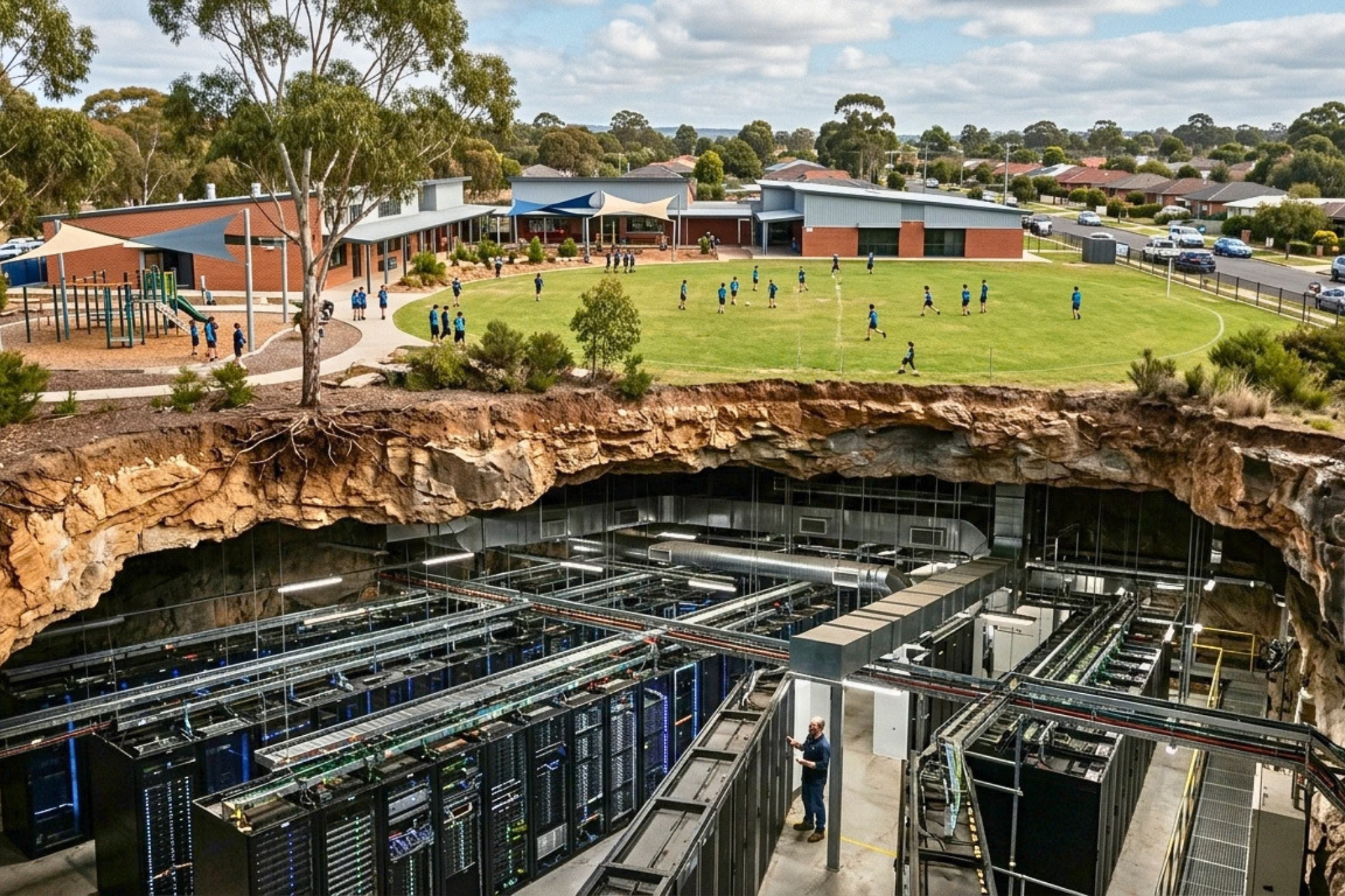

Dig deep: The future of data centres in Australia
Lane Cove is a pretty, leafy corner of Sydney. It is also a flashpoint of the increasingly ugly battle over data centres. With five built, approved or in the planning stage in the North Shore suburb, residents fear their community – named one of Australia’s most liveable in 2025 – will be lost to the artificial intelligence (AI) monoliths.
Australia is experiencing a data centre boom, with approximately 165 in operation, and a further 225 at various stages of development.
The Australian Energy Market Operator (AEMO) estimates that these centres will consume as much power as almost every home in Victoria and NSW by 2036.
“We’ve got one shot to get the rules right now and ensure that data centre growth doesn’t strain our grid and push up pollution,” Climate Council chief executive Amanda McKenzie says.
Then there is the amount of water they soak up, with Australia’s largest water utility Sydney Water predicting they could be consuming 25 percent of the city’s drinking water by 2035.
But while concerns have focused on the size of data centres, the noise they generate, and the amount of water and energy they consume, no one appears to have questioned whether Australia needs to build them above ground at all.
This is despite successful underground data centres around the world, including the Lefdal Mine Datacentre in Norway and Iron Mountain in Pennsylvania, that negate community concerns and dramatically reduce consumption of water and electricity.
Going underground
In a submission to the Senate inquiry into artificial intelligence and data centres, Handle My Complaint CEO Jo Ucukalo proposes a national framework that:
-
- Treats underground construction as the default for data centres
- Prioritises the use of Australia’s 80,000 disused mine voids
- Ensures that land above subsurface facilities is reserved for public, community or commercial use that governments want near technological infrastructure
“Data centres are large-scale data farms whose operational requirements make them well suited to subsurface construction,” she says.
The former engineer, who has worked on a range of major projects including underground formwork and foundation approvals for London’s City Hall, took a tour of a New South Wales data centre to get a better picture of what’s inside.
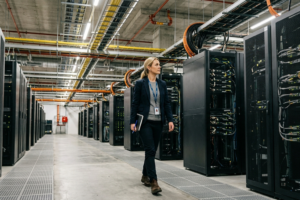
“Two things surprised me, the first was the noise – it is genuinely loud in there,” she says. “The second was that you have no idea where you are. There is no wayfinding at all, because wayfinding is for people.”
In fact, the only person onsite was security. These buildings house racks of computers that run the things we use every day, such as banking apps, streaming services, maps and AI. Once you’ve stood in one, she argues, the question of what belongs on the surface and what doesn’t more or less answers itself.
“They aren’t workplaces in any normal sense,” Ms Ucukalo says. “The racks don’t need natural light or fresh air; they need a tightly controlled environment, which is much closer to what you get underground than to a surface site fighting the weather all year round.”
Keeping our cool
In Australia, where temperatures can swing from single digits in winter to more than 40C in summer, above ground sites battle to keep the server inlet temperature constant, using chillers, air handlers and, in some cases, evaporative cooling. Electricity is required to manufacture every degree of difference.
Below ground is another story. In the same way an underground hydro plant or storage cavern uses geology as part of the thermal-management system, the rock mass surrounding an underground data centre acts as a heat sink that is already close to the ideal temperature. It is passive, permanent and use far less energy or water.
“Why are we putting the part that doesn’t need the surface on the surface? Put the computer below and the hospitals, schools, research space and housing above,” Ms Ucukalo says. “Governments already say they want data centres near users and innovation precincts – this is how you do that without industrialising the street.”
With our environment and knowhow, the nation should be leading the way in underground data centres.
“Australia is in the middle of one of the biggest tunnelling booms in the developed world – Sydney Metro, the Metro Tunnel, West Connex, Cross River Rail, the Western Harbour Tunnel,” Ms Ucukalo says.
“On top of that, we have generations of mining expertise in shaft sinking, ground support and ventilation. We already know how to do this.”
Mining for gold
One of the tenets of Handle My Complaint’s submission to the Senate inquiry involves building data centres in some of Australia’s 80,000 disused mining sites.
While many of these sites are unfit for purpose, the entire forecast data centre fleet for 2036 could be accommodated in a very small number of large voids. Even if just one percent of the mines proved viable, there would be 800 candidates for 225 facilities.
The submission cites several key reasons why disused mines would work:
-
- The excavation is done. The most costly part of construction – the digging – was completed years ago. What remains is the fitout.
- The thermal environment is free. At the depths of a typical mine, the host rock is functionally a heat sink holding 16-19C, something surface facilities spend huge amounts of energy manufacturing.
- The infrastructure is largely in place. Mines need heavy site access, haul roads, ventilation shafts, water management and electrical supply. The retirement of coal-fired generation in the Hunter and LaTrobe valleys also leaves the grid connection capacity a large data centre needs in the same regions as the voids.
- The communities already know industry. Mining districts are not residential suburbs discovering an industrial neighbour for the first time. Many regional towns are actively seeking the long-term employment a data centre would bring.
In addition, the process would turn a liability into an asset, stabilising the site, making the land productive, and bringing employment. “It’s one of the few infrastructure choices in which the cheapest option is also the safest, the most secure and the most acceptable to the community,” Ms Ucukalo says.
The Hunter Valley is an example. Some of its voids are hundreds of metres deep, and the temperature at the bottom can be several degrees cooler than at the surface — which means less water is needed for cooling.
“We’ve got these well designed spaces at the bottom of the pits. Why wouldn’t we be looking at using it for industrial purposes rather than filling it in and pretending it will be great agricultural land,” Energy Estate co-founder Simon Currie told the Newcastle Herald in June 2026. “Most of them are close to the grid and it’s a lot cooler and stable down there so you don’t need as much water.”
The region is already drawing interest. BHP, which is scheduled to close its Mt Arthur mine in 2030, says it is looking at how the land and existing infrastructure there could support new industries, training and energy projects once mining ends. An international technology and infrastructure consortium is reported to be preparing plans for a $10 billion data centre at Muswellbrook, paired with a two-gigawatt battery that would be the largest in Australia.
Mining companies are already exploring options, with Fortescue lobbying the State Government to change laws to enable the Western Australian miner to build (and run) a data centre in the Pilbara.
“We need to bring the data to the power, not the other way around,” Mr Currie says. “We need to work out how we get the industry to look beyond Macquarie Park and the outskirts of Melbourne.”
Turning a cost into an income
Leaving the voids as they are isn't free. Cleaning up a single large mine can cost hundreds of millions of dollars. The state government holds a bond as security but it often covers only a fraction of the costs. If an operator walks away or goes broke, the public pays the difference and the community is left with the hole.
In 2021, the state held about $3.3 billion in rehabilitation bonds across every mine in NSW. An Australia Institute report estimated that filling the Upper Hunter's mine voids alone would cost $12–25 billion. At the Russell Vale colliery near Wollongong, the bond was $12.3 million against an estimated clean-up bill of $215 million.
"It's obvious the remediation bonds are inadequate," former prime minister Malcolm Turnbull said that year, as he called for a NSW parliamentary inquiry into mine rehabilitation.
Where mines were abandoned before modern bonds existed, taxpayers foot the bill directly. The 2021 NSW Budget set aside $108 million over ten years to remediate legacy mine sites. Queensland is spending $70.6 million over four years just to monitor, manage and secure its abandoned mines. In Victoria, the Auditor-General found in 2020 that the $813 million in bonds the state held could be $361 million short of the real cost.
A data centre changes that equation. Instead of spending public money to fill a hole, the void is made safe and stable for good. The operator pays to use it, the land earns an income again, and the region gains long-term jobs.
"Every void converted is one less for taxpayers to fill, fence or monitor," Ms Ucukalo says.
Handle My Complaint's submission asks that rehabilitation bond rules recognise this. A company that converts a void into a data centre, and permanently stabilises it, should get credit for the clean-up obligation it takes off the public's hands.
Putting pressure on housing market
Some data centres can not be located in regional areas. Many need access to major power supplies, the NBN and customers, which naturally draws them to the city.
But this has to be carefully managed to stop the environmental and societal impacts explored in Four Corners’ The AI Race, and being felt from Lane Cove in Sydney to Yarraville in Victoria, spreading across the country.
“Where a data centre genuinely requires a metropolitan location, our position is not that it should be refused,” Ms Ucukalo says. “It is that it should go under the city rather than beside a primary school in it.”
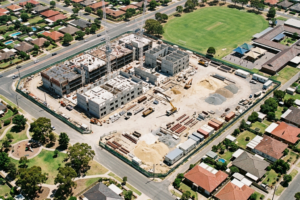
One of the reasons is the scarcity of land in Australian cities. Housing Industry Association CEO Simon Croft says data centres are already displacing housing projects.
“There are examples in states such as Victoria and NSW where land previously earmarked for housing is being fast-tracked for data centre development,” Mr Croft says. “It is entirely conceivable that a data centre spanning many hectares could be approved faster than a single home."
Australians are being pushed further out of the city, increasing urban sprawl, or sharing their neighbourhood with large, noisy boxes that consume power and water and give little in return.
“Imagine a precinct where the compute powering research and digital health is below the ground and an innovation and research campus sits above,” Ms Ucukalo says. “It would be linked to housing, schools and communities and transport, integrating important digital infrastructure and the liveability of the area, rather than one destroying the other.”
Sharing the load
Australians are bearing the cost for the lack of government regulation and oversight of data centres.
Housing is one issue. The pressure these centres put on our electricity and water systems inevitably leads to upgrades that flow on to everyone already connected, be it through electricity tariffs or increases in water bills.
Worse still, they have no one to complain to who can do anything about it. If your telco lets you down, you go to the Telecommunications Ombudsman, if your energy retailer overcharges, if your bank or insurer does the wrong thing, you can take it to the Australian Financial Complaints Authority, and so on.
“Each of these is industry-funded, free to the consumer and able to make binding determinations,” Ms Ucukalo says. “If a data centre a few hundred metres from your home runs its generators during testing and you cannot sleep, your options are to complain to the operator, to a council that had no role in approving it, or to a state agency that did. There is no scheme, no binding determination, no free pathway and no aggregated public record.”
Handle My Complaint is calling for a complaints scheme modelled on existing ombudsman arrangements. It should be industry funded by levy and cover noise, emissions, light traffic, water pressure, and grid cost pass-through, with binding determination powers and public reporting.
Helping the community
Data centres make a lot of money for their operators, most of which are private undertakings, while the communities that host them carry the physical and financial impact. This creates greater conflicts and resentment, with Resources Minister Madeleine King noting the troubling views around data centres globally.
“If these data centres do not have social licence and community acceptance, Australia could experience a very short-term boom where nobody is really happy,” she says.
Handle My Complaint's submission argues for a net-positive framework that would ensure the community also benefits. This could be a tax, levy, rebate or contractual value-return scheme with proceeds directed to electricity and water bill relief, local infrastructure funds and community benefit programs.
This already works in the United States, in myriad ways:
-
- Richland Parish, Louisiana – Meta reports teacher bonuses of up to $US50,000; $US1.6 billion in contracts to Louisiana businesses; more than $US1 billion in local infrastructure; and a $US5 million scholarship fund – in a community of about 20,000 people.
- Ellendale, North Dakota – Households anticipate reductions in their electricity bills of about $US250 a year once the data centre project is fully built.
- Georgia and Michigan – Georgia’s regulator froze Georgia Power’s base rates until at least 2028 while bringing in new rules for large users such as data centres. Michigan’s regulator has required that data centre connections not be subsidised by other customers.
"None of this requires new policy invention,” Ms Ucukalo says. “Existing mechanisms just need to be applied so that Australians share in the benefits of these data centres.”
Time for change
Data centres are rolling out faster than any regulations in the pipeline to protect our water and power.
Putting these power-hungry beasts underground will not only mitigate the pressure on crucial infrastructure but also protect Australian communities.
This will require planning authorities to stop treating data centres as industrial buildings that go on land and start asking whether they even need to be above-ground.
“A data centre is less an industrial building than an industrial load and its physical form is far more flexible than the planning system assumes,” Ms Ucukalo says.
“The country has the workforce, the mining capability, the geotechnical expertise, the mine void inventory and the planning authority. It just lacks the siting authority that makes underground the default and above-ground the exception.”
Dig a little deeper
Data centres are changing our communities, power and water use. Have your say and receive updates on Australia’s data centre boom.