
Waste not: Put data centre heat and wires to work
In the small Finnish town of Mantsala, north of Helsinki, residents are kept warm through the long winter by an unlikely source.
Since 2015, a data centre has piped its waste heat into Mantsala’s network. In the past two years, it has covered up to 72 percent of the town’s annual heating demand and has also slashed heat-related emissions by more than half. Operator Nebius is now expanding the site, with heat recovery built into the architecture.
In Australia, all that heat simply goes into the air – and to waste.
“Almost all the electricity a data centre uses ends up as heat,” Handle My Complaint CEO Jo Ucukalo says. “In Europe data centre heat warms homes, pools and whole towns. Moreover, the law increasingly requires it. Here, we vent it into the streets.”
And it’s not all we’re wasting. In Handle My Complaint’s follow-up submission to federal and state governments reinforcing the benefits of taking data centres underground, Ms Ucukalo argues that the heat these monoliths generate, and the wires that carry power and data, should be treated as public assets rather than by-products.
Harnessing the heat
The amount at stake is growing sharply. The Australian Energy Market Operator (AEMO) expects data centres to use about 34 terrawatt hours a year by 2035-2036, up from 3 percent to 13 percent of electricity supplied through the grid. This is almost as much power as every home in New South Wales and Victoria.
Above ground data centres spend a large share of energy getting rid of heat, using fans, chillers and cooling towers, and often drinking water.
“If the heat is captured in a sealed loop and lifted with a heat pump, it can be put to good use – warm water for a pool, greenhouse or even a fish farm,” Ms Ucukalo says.
Finland isn’t the only place putting the heat generated by data centres to good use. Stockholm’s heating utility buys surplus heat from data centres and feeds it into the city’s network. During the 2024 Paris Olympics, excess heat from an Equinix data centre was used to warm the Olympic pools.

Since October 2025, the European Union’s Energy Efficiency Directive has required data centres above 1MW to reuse their waste heat unless it isn’t technically or economically feasible. Germany’s Energy Efficiency Act sets rising targets for new faciliities: 10 percent of energy must be reused as heat from July 2026, increasing to 20 percent by 2028.
“Australia has no equivalent rule,” Ms Ucukalo says.
Going underground makes sense
With little district heating in Australia, the Nordic model would not be replicated. However, there is plenty of opportunity to use the heat generated in other ways, including for fish farms, greenhouses, food processing, public pools and other low-temperature industrial settings, many of them in regional and mining towns.
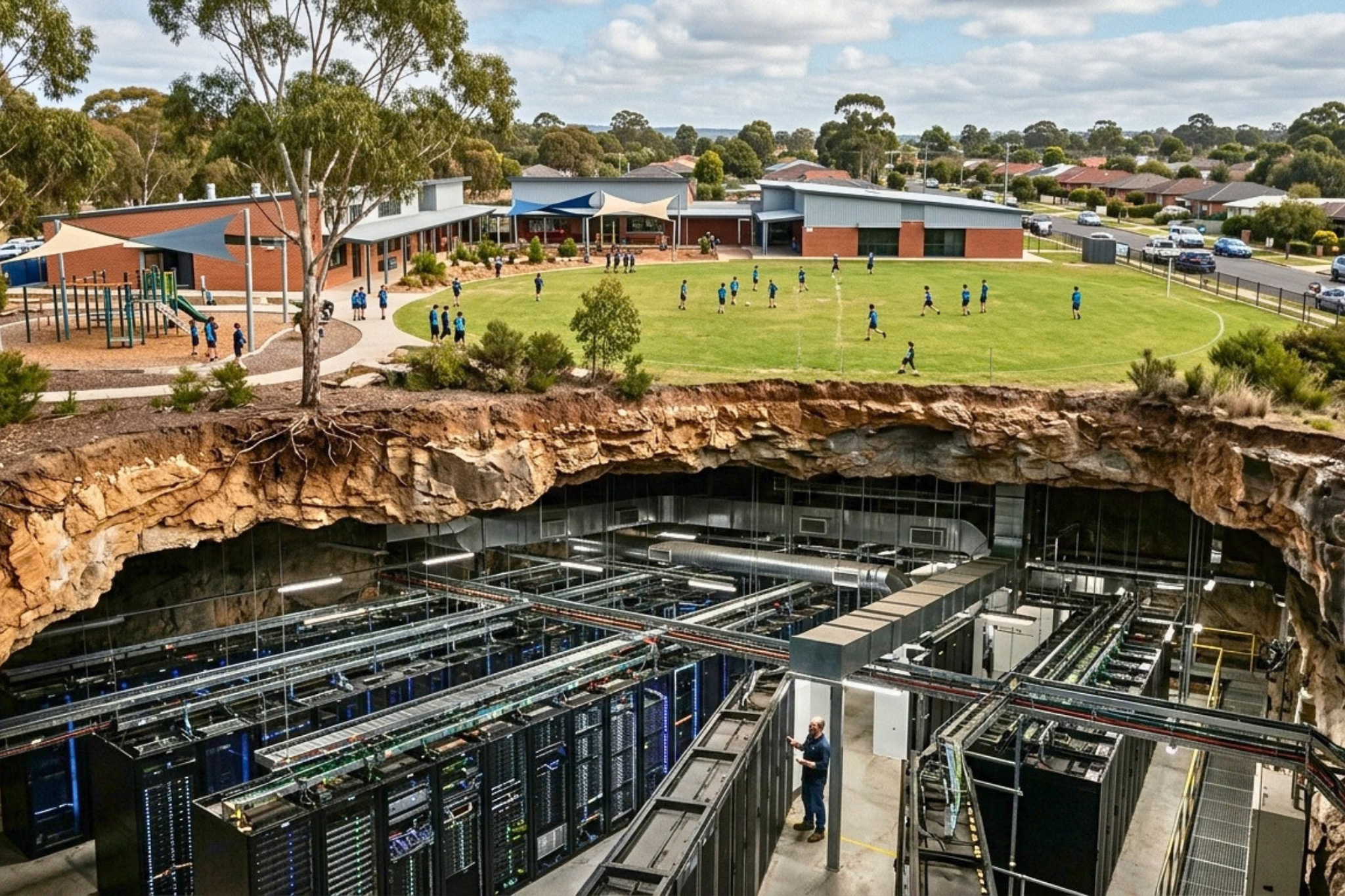
This ties directly to Handle My Complaint’s first submission to the Senate inquiry into artificial intelligence and data centres, which outlines the case for making mining voids the default location for new data centres.
“Going underground makes heat recovery easier, not harder,” Ms Ucukalo says. “A data centre in a mine can’t vent heat the way a surface building does. It needs engineered cooling loops and shafts, and that same engineering delivers the heat in a form you can pipe to a user.”
Underground facilities operating overseas show the engineering works. Data centres: Building Australia’s next generation of infrastructure sets out a plan to harness that heat for Australians, with a heat reuse plan for every lease of a public mine void and every approval of a data centre above 1MW.
Each plan would include a feasibility test, a reuse target that rises over time, and lease terms that set out who owns the heat. Any heat revenue generated would go to a fund that directly benefits the host region.
“A data centre in a regional town can give back more than jobs and rent,” Ms Ucukalo says. “But you must plan for the heat before the facility is built.”
Wiring the future
Then there are the wires that carry the data and power. A civil engineer who has consulted on electricity network investment at Ergon Energy and Energex, Ms Ucukalo says Australia should learn from the mistakes of rooftop solar.
More than four million Australians have installed panels, with a rollout that soon outpaced the grid. When whole streets began exporting power at midday, voltages rose and systems tripped. Many households were capped at 5kW of exports, some at 1.5kW and some at zero, effectively rendering their energy savers useless.
In 2021, the Australian Energy Market Commission changed the rules, acknowledging that the grid hadn’t been built for two-way flows, and making it clear that networks must treat solar exports as a service.
The fix depends on internet connection. Under South Australia’s flexible exports arrangements, for example, a home’s export limit changes through the day with local conditions, allowing up to 10kW per phase. If the home’s internet drops out, the system falls back to 1.5kW.
“The electricity grid now runs on telecommunications,” Ms Ucukalo says. “A home’s ability to sell its solar power depends on its internet connection.”
Making fibre part of grid upgrades
With the grid about to be rebuilt again, to accommodate data centres, electric vehicles and renewables, it is crucial Australia learn from the mistakes of the solar experience. Wherever power is upgraded, fibre should be part of the process, rather than added later.
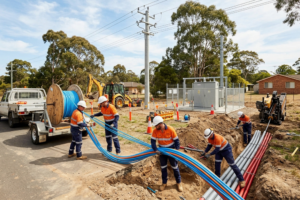
“Every new pole, line and substation upgrade is a chance to lay public fibre alongside it, so the same trench or pole route builds both networks,” Ms Ucukalo says.
Overseas experience shows what works, and what doesn’t. Attempts by utilities and councils in the United States, Spain and Germany to sell internet over power lines to households mostly failed against cheaper competitors. But utilities using their own wires to run their own networks succeeded at scale. France’s Enedis and Italy’s Enel each read tens of millions of meters over power lines.
“Public infrastructure earns most reliably when the public owner leases access to it, not when it competes for retail customers,” Ms Ucukalo says.
What it means for you
Heat put to work, rather than wasted, can provide warmth for recreational, commercial and agricultural activities. Fibre laid with every grid means households don’t pay twice for the same trench, and communities are connected wherever they live.
Combined with building data centres in mine voids, they help deliver services to regional areas, improving infrastructure, generating jobs and rejuvenating former mining towns.
Residents around the world are rallying to protest the rise of data centres, angry about the water and power they consume and the noise they generate, as well as the valuable space they take up in a tight housing market. In North America, social backlash has already resulted in $US77 billion worth of projects being blocked or delayed.
Late last month, Goodman Group withdrew its plans to build a controversial $1.2 billion data centre in Sydney’s Lane Cove. The developer blamed changing government regulations but the proposal also became a flashpoint for opposition to data centre locations. Commentators say community concern also contributed to the collapse of what would have been Australia’s second biggest stock float earlier this month. Firmus Technologies was planning to build data centres across the country, Singapore, Malaysia and Indonesia, with the backing of tech and finance heavyweights Nvidia and Blackstone.
The data centres we build in the next few years will run for 25 years or more. They should be set up so that Australians benefit from the infrastructure, rather than suffer the consequences of poor choices.
“This means building underground, using mine voids that have already been dug as a priority, and putting in public fibre at the same time as networks are upgraded,” Ms Ucukalo says.
“It also means embedding a system that requires data centres to put the heat they generate to good use. We need to harness these assets for the benefit of all Australians.”